

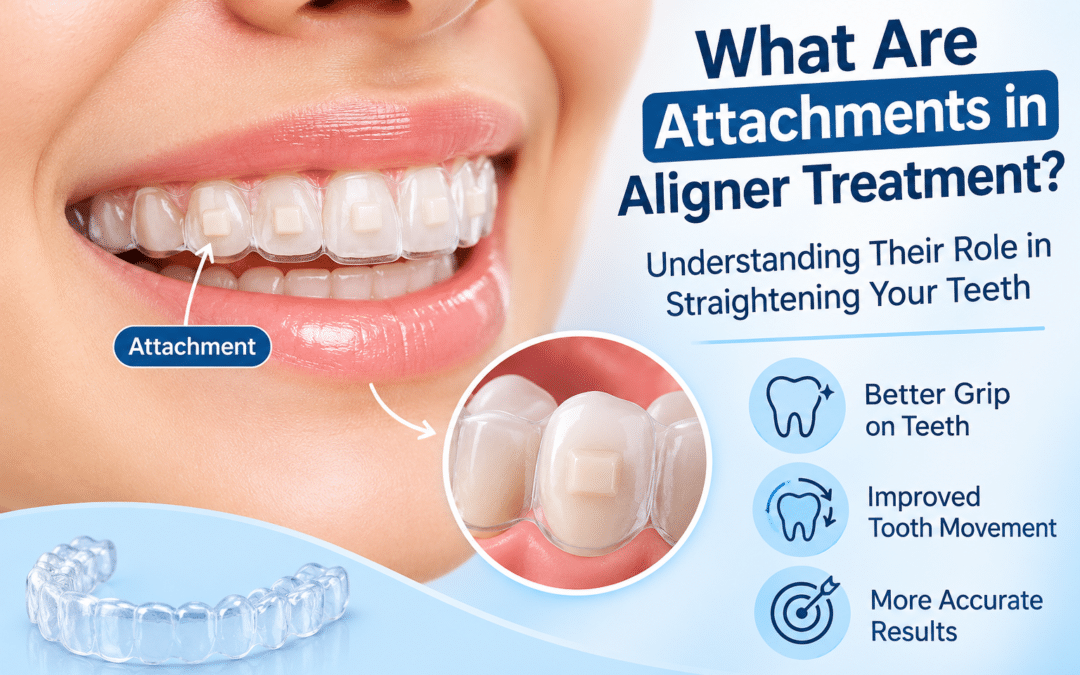
Clear aligners have become a popular choice for people who want to straighten their teeth without wearing traditional metal braces. They are transparent, removable, and designed to fit comfortably over your teeth. However, have you ever wondered how clear aligners move teeth effectively when they are smooth and do not have brackets or wires?
The answer is aligner attachments.
These small, tooth-coloured bumps play an important role in making clear aligner treatment more effective. They help aligners grip the teeth better and apply the right amount of pressure to achieve planned tooth movements.
Let’s understand what aligner attachments are, why they are needed, and how they contribute to successful orthodontic treatment.
What Are Attachments in Clear Aligner Treatment?
Attachments are small, tooth-coloured bumps made from dental composite resin that are temporarily bonded to selected teeth during clear aligner treatment.
They are carefully designed and positioned according to your digital treatment plan. Attachments act as gripping points, allowing clear aligners to hold the teeth firmly and guide them into their desired positions.
Depending on your treatment requirements, attachments may have different shapes, sizes, and orientations.
Although they may look like small raised spots on your teeth, they serve an important purpose in achieving accurate tooth movement.
Why Are Attachments Needed in Aligner Treatment?
Clear aligners work by applying controlled pressure to gradually move teeth. However, certain tooth movements can be challenging when aligners rely only on their fit around the teeth.
Attachments help overcome this limitation.
Here are some important reasons why orthodontists recommend attachments:
- Better Grip and Retention
Attachments provide additional gripping points, helping aligners stay properly seated on the teeth throughout treatment.
- Improved Tooth Rotation
Some teeth, particularly rounded teeth such as canines and premolars, can be difficult to rotate. Attachments help the aligners apply controlled forces to achieve the required rotation.
- Effective Vertical Tooth Movement
Certain movements, such as raising or lowering a tooth, require additional force control. Specially designed attachments can help support these movements.
- Better Control of Tooth Position
Attachments help orthodontists achieve more predictable tooth movements by improving how forces are transferred from the aligners to the teeth.
- Support for Complex Orthodontic Corrections
In cases involving crowding, spacing, or complicated tooth positions, attachments may help achieve the planned results more effectively.
What Are the Different Types of Aligner Attachments?
Attachments come in different shapes and sizes depending on the type of tooth movement required.
Some commonly used designs include:
- Rectangular Attachments: Often used to improve aligner grip and support controlled tooth movements.
- Bevelled Attachments: Designed with angled surfaces to help achieve specific movements.
- Optimised Attachments: Specially designed using digital treatment planning to support particular tooth movements.
- Vertical Attachments: May be used to assist with rotation and certain other movements.
Your orthodontist will decide the appropriate attachment design based on your individual dental condition and treatment goals.
How Are Attachments Placed on Teeth?
Getting attachments placed is generally a simple and minimally invasive dental procedure. It usually involves the following steps:
Step 1: Digital Treatment Planning
Your orthodontist evaluates your teeth using digital scans, photographs, and other necessary records to plan the aligner treatment.
Step 2: Tooth Preparation
The selected teeth are cleaned and prepared to ensure proper bonding of the attachments.
Step 3: Attachment Placement
A tooth-coloured composite resin is placed using a customised template and bonded to the selected teeth.
Step 4: Curing and Finishing
A special dental light is used to harden the composite material. The orthodontist checks the attachments and ensures that the aligners fit correctly.
Step 5: Aligner Fitting
Your clear aligners are fitted over the teeth, allowing the attachments to engage with the aligners and support the planned tooth movements.
Are Aligner Attachments Painful?
Attachment placement is generally painless and does not usually require injections or drilling.
However, you may experience mild pressure or discomfort when wearing a new set of aligners, especially during the first few days. This is usually temporary and occurs because your teeth are gradually moving into new positions.
You may also initially notice the attachments when your tongue touches your teeth, but most patients adapt to them over time.
Are Attachments Visible When Smiling?
Attachments are usually made from tooth-coloured composite resin, making them less noticeable than traditional metal braces.
However, they may be slightly visible, particularly when placed on front teeth. Their visibility depends on their size, shape, placement, and the individual’s tooth shade.
Despite this, clear aligners with attachments generally maintain a discreet appearance.
How Should You Care for Your Attachments During Aligner Treatment?
Proper oral hygiene is important throughout your aligner treatment. Follow these simple tips:
- Brush your teeth twice daily using a soft-bristled toothbrush.
- Clean carefully around the attachments to prevent plaque accumulation.
- Floss regularly to maintain healthy gums.
- Remove your aligners before eating or drinking anything other than water.
- Clean your aligners regularly as instructed by your orthodontist.
- Avoid biting hard objects or using your teeth to open packages.
- Wear your aligners for the recommended duration each day.
- Contact your orthodontist if an attachment becomes loose or falls off.
What Happens When Attachments Are Removed?
Once your aligner treatment is completed, your orthodontist will carefully remove the attachments using specialised dental instruments.
The remaining composite material is gently polished to restore the natural tooth surface. Attachment removal is generally straightforward and does not involve removing any natural tooth structure when performed correctly.
Your orthodontist may also recommend retainers to help maintain your newly aligned teeth and prevent them from shifting back.
Do All Patients Need Attachments for Clear Aligner Treatment?
No. Not every patient requires attachments.
The need for attachments depends on several factors, including:
- The severity of tooth crowding or spacing.
- The type of tooth movement required.
- The position and shape of individual teeth.
- The complexity of the orthodontic correction.
- The digital treatment plan.
Your orthodontist will assess your teeth and determine whether attachments are necessary for achieving the desired results.
Get Expert Guidance for Clear Aligner Treatment in Madurai
Clear aligner treatment involves more than simply wearing transparent trays. Every stage, including digital planning, attachment placement, aligner changes, and follow-up appointments, plays an important role in achieving a healthy and well-aligned smile.
At Meenakshi Super Speciality, Madurai, Dr. Jibreel Oysul provides professional dental guidance and orthodontic care based on individual treatment requirements.
If you are considering clear aligners or want to know whether attachments are necessary for your teeth, consult an orthodontic professional for a personalised evaluation.
Book your dental consultation at Meenakshi Super Speciality, Madurai, and take the next step towards a confident smile.
Frequently Asked Questions (FAQs)
- What are attachments in aligner treatment?
Attachments are small, tooth-coloured composite resin bumps bonded to selected teeth to help clear aligners grip teeth and achieve planned movements.
- Do aligner attachments damage teeth?
When properly placed and removed by a dental professional, attachments generally do not damage natural tooth structure.
- Can I eat with aligner attachments?
Yes. Attachments remain bonded to your teeth while eating. However, clear aligners should be removed before meals.
- How long do attachments stay on teeth?
Attachments generally remain on the teeth throughout the active aligner treatment and are removed after the planned tooth movements are completed.
- Do attachments make clear aligners less invisible?
Attachments may be slightly noticeable because they are bonded to the teeth. However, tooth-coloured composite makes them relatively discreet compared with traditional metal braces.
- What should I do if an aligner attachment falls off?
Contact your orthodontist for an evaluation. Do not attempt to bond it back yourself. Your orthodontist will determine whether it needs replacement.