

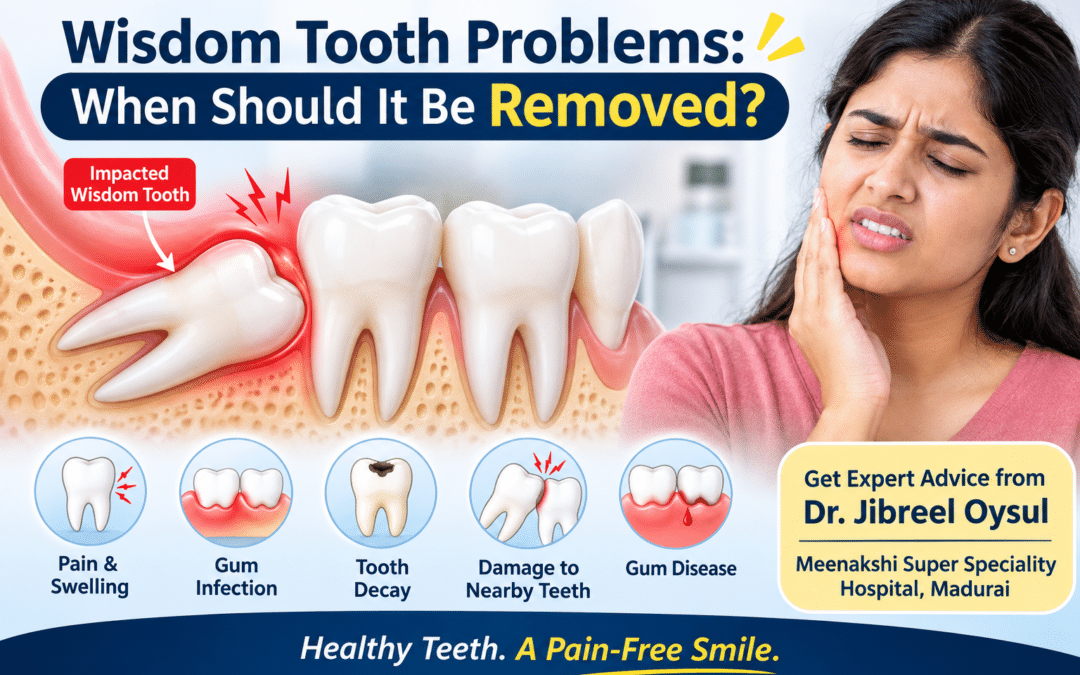
Wisdom teeth are the last set of molars to develop in the mouth, usually appearing between the ages of 17 and 25. While some people develop wisdom teeth without any complications, others may experience pain, swelling, infection, and difficulty chewing.
Wisdom teeth do not always need to be removed. However, when they grow in the wrong direction, become impacted, or cause repeated dental problems, removal may be necessary to protect your oral health.
Understanding the warning signs and knowing when to consult a dentist can help prevent complications.
At Meenakshi Super Speciality Hospital, Madurai, Dr. Jibreel Oysul provides dental evaluation and guidance to help patients manage wisdom tooth-related problems and understand the appropriate treatment options.
What Is a Wisdom Tooth?
Wisdom teeth are the third molars located at the back of the upper and lower jaws. Most adults have up to four wisdom teeth, although some people may have fewer or none at all.
These teeth generally emerge during late adolescence or early adulthood. Since they are the last teeth to develop, there may not be enough space in the jaw for them to erupt properly.
As a result, wisdom teeth may grow at an angle, remain partially visible, or stay trapped beneath the gum tissue or jawbone. This condition is known as an impacted wisdom tooth.
Common Wisdom Tooth Problems
When wisdom teeth do not emerge properly, they can lead to several oral health complications.
1. Impacted Wisdom Teeth
An impacted wisdom tooth occurs when the tooth cannot fully emerge through the gum due to insufficient space or an incorrect position.
Common symptoms include:
- Pain at the back of the mouth
- Swelling around the gums
- Difficulty opening the mouth
- Discomfort while chewing
- Pressure near neighbouring teeth
Impacted wisdom teeth may require removal depending on their position and associated complications.
2. Pericoronitis (Gum Infection Around Wisdom Teeth)
Pericoronitis is an inflammation or infection of the gum tissue surrounding a partially erupted wisdom tooth.
Food particles and bacteria can accumulate beneath the gum flap covering the tooth, resulting in infection.
Symptoms may include:
- Pain and swelling around the wisdom tooth
- Redness and tenderness of the gums
- Bad breath or an unpleasant taste
- Difficulty swallowing in more severe cases
- Fever and facial swelling if the infection spreads
Prompt dental evaluation is important, particularly when swelling, fever, or difficulty swallowing develops.
3. Tooth Decay
Wisdom teeth are located at the back of the mouth, making them difficult to clean properly. Food particles and plaque can accumulate around these teeth, increasing the risk of cavities.
If decay becomes severe, it may affect the wisdom tooth or even the neighbouring second molar.
4. Damage to Nearby Teeth
A wisdom tooth growing sideways or at an angle can press against the neighbouring molar. This may contribute to tooth decay, gum problems, or damage to the adjacent tooth.
Early assessment can help prevent further complications.
5. Gum Disease
Partially erupted or poorly positioned wisdom teeth can create areas where plaque and bacteria accumulate.
This may cause gum inflammation, bleeding, swelling, and periodontal problems around the wisdom tooth and neighbouring teeth.
When Should a Wisdom Tooth Be Removed?
Not every wisdom tooth requires extraction. Your dentist may recommend removal when the tooth causes symptoms or presents a significant risk to surrounding teeth and tissues.
Here are some situations where wisdom tooth removal may be necessary:
- Repeated Pain and Swelling
If you experience recurring pain, swelling, or discomfort around your wisdom tooth, removal may be recommended after clinical evaluation.
- Repeated Gum Infections
Repeated episodes of pericoronitis may indicate that the wisdom tooth is not erupting properly and requires further treatment.
- Severe Tooth Decay
When a wisdom tooth develops extensive decay that cannot be restored effectively, extraction may be the appropriate option.
- Damage to the Adjacent Tooth
If the wisdom tooth is damaging the neighbouring molar or contributing to decay and gum disease, removal may help protect the surrounding teeth.
- Cysts or Other Abnormalities
In some cases, an impacted wisdom tooth may be associated with a cyst or other pathological changes around the tooth. Surgical removal and appropriate treatment may be necessary.
- Difficulty Maintaining Oral Hygiene
If the position of the wisdom tooth makes it difficult to clean and leads to repeated dental problems, your dentist may discuss removal.
What Are the Warning Signs That You Should Not Ignore?
Consult a dentist if you experience any of the following symptoms:
- Persistent pain at the back of your mouth
- Swelling around the jaw or gums
- Difficulty opening your mouth
- Pain while chewing or swallowing
- Repeated gum infections
- Pus discharge around the wisdom tooth
- Bad breath or an unpleasant taste that persists
Important: Fever, rapidly increasing facial or neck swelling, or difficulty swallowing or breathing may indicate a spreading infection and require urgent medical attention.
How Is Wisdom Tooth Removal Performed?
Wisdom tooth removal is a common dental procedure. The treatment approach depends on whether the tooth has fully erupted or is impacted.
Step 1: Dental Examination
The dentist examines the wisdom tooth, surrounding gums, and neighbouring teeth to identify any complications.
Step 2: Dental X-ray
An X-ray helps assess the position, angle, and root structure of the wisdom tooth. It also helps evaluate its relationship with nearby anatomical structures, including nerves in the lower jaw.
Step 3: Local Anaesthesia
Local anaesthesia is generally administered to numb the affected area and minimise discomfort during the procedure. Sedation or other anaesthesia options may be considered in selected cases.
Step 4: Tooth Extraction
A fully erupted wisdom tooth may be removed using a routine extraction technique. An impacted wisdom tooth may require a minor surgical procedure involving an incision in the gum and, sometimes, removal of a small amount of surrounding bone.
Step 5: Post-Extraction Care
After removal, the dentist provides instructions to support healing, reduce discomfort, and prevent complications.
Tips for Recovery After Wisdom Tooth Removal
Following your dentist’s post-operative instructions is important for a smooth recovery.
- Apply gentle pressure on the gauze as advised to control bleeding.
- Use prescribed medications as directed.
- Apply an ice pack externally to help reduce swelling.
- Eat soft foods such as curd, mashed potatoes, and soft-cooked foods.
- Avoid smoking and alcohol during the healing period.
- Avoid using straws and forceful spitting, particularly during the initial healing period.
- Do not disturb the extraction site with your fingers or tongue.
- Maintain oral hygiene carefully while avoiding direct brushing over the extraction wound initially.
Most patients recover gradually over several days, although complete healing may take longer depending on the complexity of the extraction.
Frequently Asked Questions (FAQs)
1. At what age should wisdom teeth be removed?
Wisdom teeth commonly emerge between 17 and 25 years of age. However, there is no fixed age for removal. Extraction depends on symptoms, tooth position, and the presence of associated dental problems.
2. Do all wisdom teeth need to be removed?
No. Healthy wisdom teeth that have erupted properly, function normally, and can be cleaned effectively generally do not require removal. Regular dental monitoring is important.
3. Is wisdom tooth removal painful?
The procedure is generally performed under local anaesthesia, so patients should not feel sharp pain during extraction. Some discomfort, swelling, and soreness may occur after the procedure and can usually be managed with prescribed medication.
4. How long does it take to recover after wisdom tooth removal?
Initial recovery usually takes a few days. Swelling and discomfort generally improve gradually, while complete healing of the extraction site may take several weeks.
5. Can an impacted wisdom tooth cause headaches or jaw pain?
An impacted wisdom tooth may cause pain around the jaw and surrounding areas. However, headaches can have several causes, so proper dental and medical evaluation is necessary to identify the underlying reason.
6. What happens if I ignore an infected wisdom tooth?
Ignoring an infected wisdom tooth may lead to recurring infection, increased pain, swelling, and in some cases, the spread of infection to nearby tissues. Early dental treatment helps prevent complications.
Conclusion
Wisdom teeth can develop without causing any problems, but improper eruption, impaction, tooth decay, and repeated gum infections may make removal necessary. Recognising the warning signs and seeking timely dental advice can help protect your neighbouring teeth and overall oral health.
If you are experiencing wisdom tooth pain, swelling, or recurring gum infections, do not ignore the symptoms.
Consult Dr. Jibreel Oysul at Meenakshi Super Speciality Hospital, Madurai, for a professional dental evaluation and guidance on appropriate wisdom tooth treatment.
Take the right step towards maintaining healthy teeth and gums with timely dental care.