

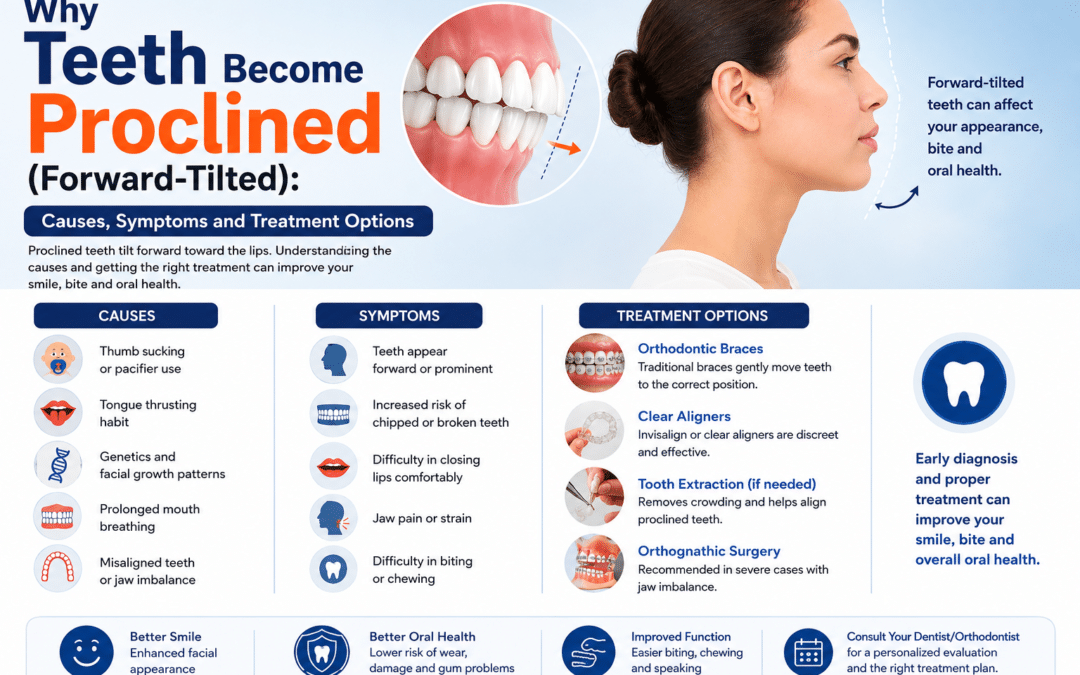
What Problems Can Proclined Teeth Cause?
Not everyone with proclined teeth will experience problems. However, more pronounced cases may be associated with:
- A noticeable change in smile or facial profile.
- Difficulty closing the lips comfortably.
- Increased overjet.
- Difficulty biting in certain situations.
- Speech or swallowing concerns in some patients.
- Increased vulnerability of prominent front teeth to accidental injury.
- Difficulty maintaining good oral hygiene in areas affected by irregular alignment.
Children with significantly protruding front teeth may have a greater risk of damaging these teeth during falls or accidents.
How Are Proclined Teeth Diagnosed?
The first step is a detailed orthodontic examination.
Your orthodontist may evaluate:
- The position and angle of the front teeth.
- Overjet and overbite.
- Crowding and spacing.
- The relationship between the upper and lower jaws.
- Facial profile.
- Lip posture.
- Tongue position and oral habits.
- Gum and supporting-tissue health.
Depending on the case, photographs, dental scans, X-rays or other diagnostic records may be recommended.
A proper diagnosis is important because the same appearance can have different underlying causes. Treatment should therefore be planned according to the individual patient’s dental and skeletal characteristics.
Can Proclined Teeth Be Corrected?
Yes. Many cases of proclined teeth can be corrected with orthodontic treatment.
However, the appropriate treatment depends on the patient’s age, tooth position, jaw relationship, available space, bite and overall oral health.
Braces
Fixed braces can apply controlled forces to gradually change the position and inclination of teeth. They can also be used to coordinate the upper and lower dental arches and improve the bite.
Clear Aligners
In selected cases, clear aligners may be used to correct tooth alignment and inclination. Whether aligners are appropriate depends on the complexity of the individual case.
Space Management
If crowding is contributing to forward-positioned teeth, the orthodontist may need to create or manage space as part of treatment.
This does not mean that every patient with proclined teeth needs tooth extraction. The decision must be based on a comprehensive diagnosis.
Habit Correction
When a persistent oral habit such as thumb sucking or tongue thrusting contributes to the problem, addressing the habit may be an important part of treatment.
Depending on the situation, behavioural guidance, habit-breaking appliances or muscle/tongue retraining may be considered.
Orthodontic Treatment During Growth
In children and adolescents, early assessment can help identify developing orthodontic problems. In selected cases, treatment during growth may help manage dental or jaw-development concerns.
The appropriate timing varies from child to child.
Jaw Surgery in Severe Cases
If a major jaw discrepancy is responsible for the appearance and bite, orthodontic treatment alone may not provide sufficient correction.
In selected severe skeletal cases, orthodontic treatment may be combined with corrective jaw surgery. This is determined only after detailed assessment.
Can Proclined Teeth Correct Themselves?
The answer depends on the patient’s age and the underlying cause.
For example, stopping a persistent childhood sucking habit while a child is still growing may allow some developing dental changes to improve naturally. However, established or significant tooth and jaw discrepancies may require orthodontic treatment.
It is therefore better not to assume that forward-tilted teeth will correct themselves without an examination.
When Should You Consult an Orthodontist?
Consider an orthodontic consultation if you or your child has:
Front teeth that appear increasingly tilted forward.
- Noticeably protruding upper front teeth.
- Difficulty closing the lips comfortably.
- A large gap between the upper and lower front teeth.
- Difficulty biting or chewing.
- A persistent thumb-sucking or tongue-thrusting habit.
- Frequent injury to prominent front teeth.
- Significant crowding or irregularity.
Early assessment can be particularly helpful for children because some developing dental and jaw problems may be easier to manage when identified at an appropriate stage of growth.