

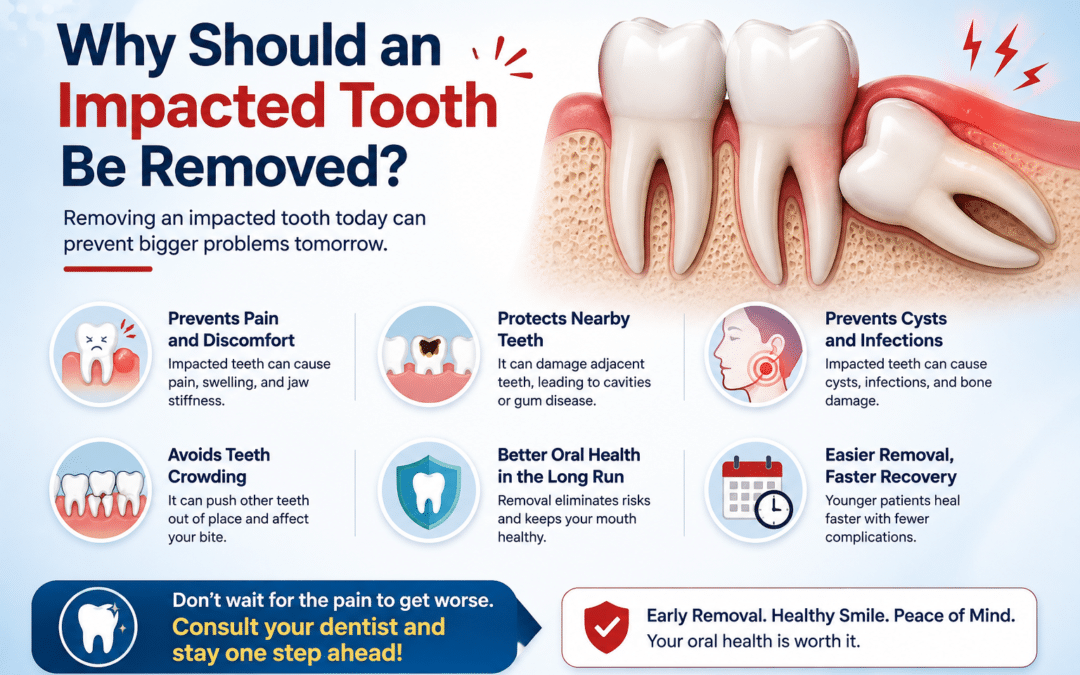
An impacted tooth is a tooth that does not fully emerge through the gums because it is blocked by another tooth, bone, or surrounding tissue. Wisdom teeth (third molars) are the most commonly impacted teeth, although other teeth can also become impacted.
Sometimes, an impacted tooth causes no immediate symptoms. This can make it easy to assume that it does not need attention. However, depending on its position and condition, an impacted tooth can increase the risk of pain, infection, damage to neighbouring teeth, and other oral health problems.
At Meenakshi Super Speciality, Madurai, Dr. Jibreel Oysul evaluates impacted teeth and recommends removal when it is clinically appropriate.
What Causes a Tooth to Become Impacted?
A tooth may become impacted when there isn’t enough space in the jaw for it to erupt normally. It may also grow at an unusual angle or become blocked by another tooth.
Wisdom teeth are particularly prone to impaction because they are the last permanent teeth to develop and often have limited space to emerge.
An impacted tooth may be:
- Partially visible through the gums
- Completely covered by gum tissue
- Completely enclosed within the jawbone
- Tilted toward the neighbouring tooth
- Positioned horizontally or at another unusual angle
A dental examination and, when necessary, dental X-rays can help determine the tooth’s position and whether treatment is needed.
Why Might an Impacted Tooth Need to Be Removed?
- To Prevent Repeated Pain and Swelling
A partially erupted impacted wisdom tooth can create a small space between the tooth and gum where food and bacteria can accumulate.
This may cause inflammation and infection around the tooth, resulting in:
- Pain
- Swollen gums
- Difficulty chewing
- Bad taste or bad breath
- Difficulty opening the mouth
If these problems repeatedly occur, your dentist or oral and maxillofacial surgeon may recommend removing the impacted tooth.
- To Reduce the Risk of Infection
An impacted tooth, especially one that is partially covered by gum tissue, can be difficult to clean properly.
Bacteria can build up around the area and cause gum inflammation or infection. Removing the problematic tooth may help prevent recurring episodes.
- To Protect the Neighbouring Tooth
An impacted wisdom tooth can sometimes press against the second molar next to it.
Depending on its position, this can contribute to:
- Food trapping
- Tooth decay
- Gum problems
- Damage to the neighbouring tooth
If an impacted tooth is putting the adjacent tooth at risk, removal may be considered.
- To Prevent Gum Problems
A partially erupted impacted tooth can make maintaining good oral hygiene difficult.
Plaque and food debris may accumulate around the tooth, increasing the risk of gum inflammation. Over time, this can affect both the impacted tooth and nearby teeth.
- To Address Cysts or Other Abnormal Changes
In some cases, an impacted tooth may be associated with a dental cyst or other changes around the tooth.
These conditions are not common, but an X-ray can help identify abnormalities that may not be visible during a routine examination.
If a cyst or other pathology is present, treatment may be necessary to protect the surrounding bone and teeth.
- To Manage an Impacted Tooth Before It Causes Complications
An impacted tooth does not necessarily have to hurt before it becomes a problem.
Some impacted teeth remain symptom-free, while others may eventually cause complications. Your dental specialist can assess factors such as the tooth’s position, symptoms, surrounding structures, and risk of future problems before recommending treatment.
Does Every Impacted Tooth Need to Be Removed?
No.
Not every impacted tooth automatically requires extraction.
If an impacted tooth is healthy, completely covered by gum or bone, not causing symptoms, and not putting nearby teeth or tissues at risk, a dentist or oral surgeon may recommend monitoring it with periodic examinations and imaging rather than immediate removal.
The decision should be based on an individual assessment.
What Happens During Impacted Tooth Removal?
The procedure depends on the position of the tooth.
Before treatment, the dental specialist will generally examine the tooth and may take an X-ray to understand its position and relationship to nearby teeth, nerves, and bone.
Depending on the case, the tooth may be removed under local anaesthesia, while some patients or more complex cases may require additional forms of anaesthesia or sedation.
If the tooth is completely or partially covered by gum or bone, a minor surgical procedure may be required to access and remove it.
Your doctor will explain the procedure, expected recovery, and aftercare instructions before treatment.
What Can You Expect After Removal?
Some pain, swelling, or discomfort can occur after an impacted tooth is removed. These symptoms usually improve as the area heals.
Your doctor may advise you to:
- Follow the prescribed medication instructions.
- Keep the extraction area clean as advised.
- Avoid smoking or tobacco during the recommended healing period.
- Choose softer foods initially.
- Avoid disturbing the blood clot at the extraction site.
- Attend follow-up appointments if advised.
Recovery can vary depending on the complexity of the extraction and the individual’s overall health.
When Should You See a Doctor?
Don’t ignore symptoms around an impacted tooth. Consult a dental or oral surgery specialist if you experience:
- Persistent pain at the back of the mouth
- Swollen gums
- Repeated gum infections
- Difficulty opening your mouth
- Pain while chewing
- Bad breath or an unpleasant taste
- Swelling of the face or jaw
- Difficulty swallowing
If you develop significant facial swelling, fever, or difficulty breathing or swallowing, seek urgent medical attention.
Takeaway
An impacted tooth may remain quiet for years, but it can sometimes lead to infection, gum problems, decay, damage to neighbouring teeth, or other complications.
Removal is not necessary for every impacted tooth. The right approach depends on its position, symptoms, surrounding structures, and potential risks.
A professional examination and appropriate imaging can help determine whether the tooth should be removed or simply monitored.
Expert Evaluation at Meenakshi Super Speciality
At Meenakshi Super Speciality, Madurai, Dr. Jibreel Oysul can evaluate impacted teeth and discuss appropriate treatment options based on the individual patient’s condition.
If you have an impacted wisdom tooth or recurring pain and swelling at the back of your mouth, don’t wait for the problem to worsen. Consult a dental/oral surgery specialist for an evaluation.