

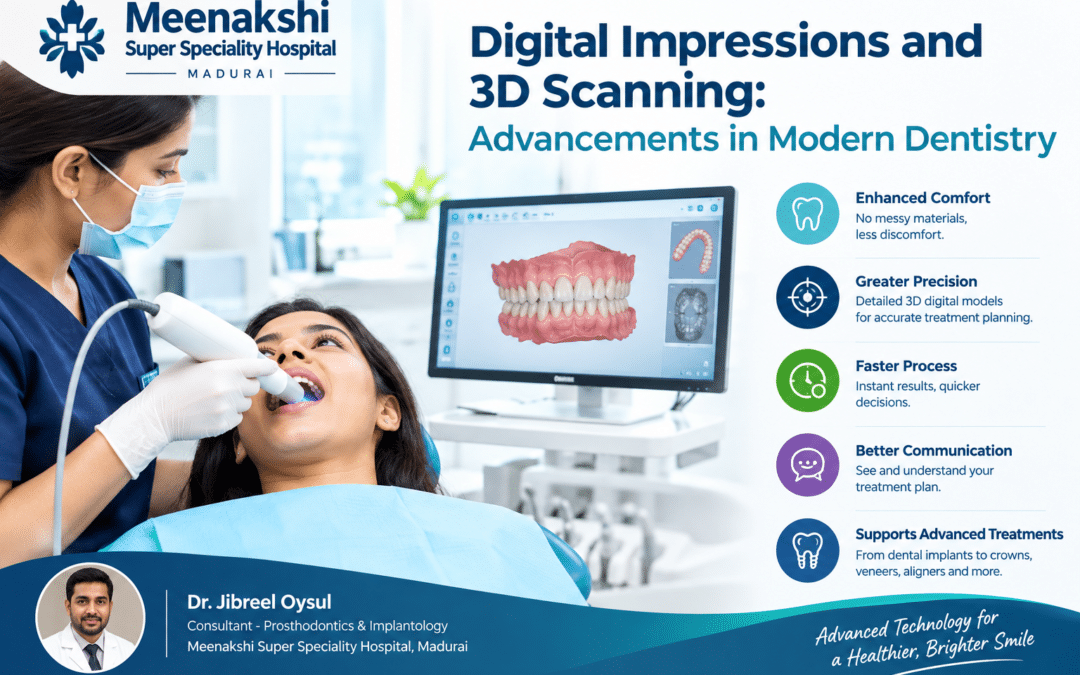
Dentistry has evolved significantly with the introduction of digital technologies. One of the major advancements in modern dental care is the use of digital impressions and 3D intraoral scanning. These technologies are changing the way dentists examine teeth, plan treatments, and create dental restorations.
At Meenakshi Super Speciality Hospital, Madurai, advanced digital dentistry can help make certain dental procedures more precise, comfortable, and efficient. Dr. Jibreel Oysul focuses on modern approaches to dental diagnosis and treatment, including the use of technology where appropriate.
What Is a Digital Dental Impression?
A traditional dental impression involves placing a soft impression material inside the patient’s mouth to create a mould of the teeth and surrounding structures.
A digital dental impression, on the other hand, uses an intraoral scanner to capture detailed images of the teeth and oral structures. The scanner creates a three-dimensional digital model that can be viewed on a computer.
This eliminates the need for conventional impression materials in many situations.
What Is a 3D Intraoral Scan?
A 3D intraoral scan uses a small handheld scanning device to capture multiple images of the teeth and oral tissues. Specialized software combines these images to create a detailed 3D representation of the patient’s mouth.
The digital model can be used for treatment planning, designing restorations, monitoring changes, and communicating treatment information with dental laboratories.
How Has 3D Scanning Advanced Dentistry?
- Greater Patient Comfort
Traditional impressions can sometimes cause discomfort, particularly when the impression material triggers a gag reflex. Digital scanning generally involves moving a small scanner around the mouth, making the process more comfortable for many patients.
- Detailed Digital Records
Digital scanners can capture detailed information about the shape and position of teeth. The resulting 3D model provides dentists with a digital record that can be reviewed during treatment planning.
- Faster Treatment Planning
Digital scans can be viewed almost immediately. Dentists can examine the digital model and use it to plan appropriate treatment without waiting for a physical impression to be processed.
- Better Communication With Patients
One of the benefits of 3D scanning is that patients can see a digital representation of their teeth on a screen. This can make it easier for the dentist to explain dental conditions and discuss possible treatment options.
- Digital Workflow for Dental Restorations
Digital impressions can be used in the planning and fabrication of certain dental restorations, such as:
- Dental crowns
- Bridges
- Veneers
- Inlays and onlays
- Some implant restorations
- Orthodontic appliances and aligners
The digital file can be transferred electronically to a dental laboratory where applicable, supporting a streamlined digital workflow.
Digital Impressions for Dental Implants
Digital scanning can also play an important role in dental implant treatment planning. A digital impression can provide information about the teeth and bite, while other imaging techniques, such as CBCT, may provide information about the underlying bone and anatomical structures.
When appropriate, combining digital information can help the dental team plan implant treatment more comprehensively.
Digital Scanning and Clear Aligners
3D intraoral scanning has also become an important part of modern orthodontic workflows. Instead of traditional moulds, a digital scan can be used to create a virtual model of the teeth.
For suitable patients, this digital model may be used in the planning of clear aligner treatment, allowing the dentist and patient to visualize the proposed movement of teeth.
Digital Dentistry: More Than Just Technology
Although digital impressions and 3D scanning offer several advantages, technology does not replace clinical expertise. The dentist still needs to examine the patient, understand their dental condition, evaluate their bite and oral health, and determine whether digital scanning is appropriate for the particular treatment.
The technology is a tool that supports diagnosis, treatment planning, communication, and workflow efficiency.
Why Choose Modern Digital Dentistry?
Digital dentistry can offer a more streamlined experience by combining advanced scanning technology with clinical expertise. From creating digital impressions to planning restorations and orthodontic treatments, 3D scanning is becoming an increasingly valuable part of modern dental care.
At Meenakshi Super Speciality Hospital, Madurai, patients can discuss their dental concerns and treatment requirements with Dr. Jibreel Oysul to understand whether digital scanning or other advanced dental technologies are suitable for their individual needs.
Frequently Asked Questions
Is a digital impression better than a traditional impression?
Digital impressions can be more comfortable and convenient for many patients and can provide an immediate digital model. However, the appropriate impression technique depends on the procedure and the patient’s individual requirements.
Is 3D dental scanning painful?
No. Intraoral scanning is generally a non-invasive procedure and does not involve injections or drilling.
How long does a digital dental scan take?
The scanning time varies depending on the procedure, the patient’s mouth, and the technology being used. In many cases, the scan can be completed relatively quickly during a dental appointment.
Can digital scans be used for dental crowns?
Yes. Digital impressions can be incorporated into the workflow for certain crowns and other dental restorations.
Can 3D scanning be used for orthodontic treatment?
Yes. Digital models created through intraoral scanning can be used for treatment planning in various orthodontic procedures, including suitable clear-aligner treatments.
Conclusion
Digital impressions and 3D intraoral scanning represent an important advancement in modern dentistry. By creating detailed digital models of the teeth, these technologies can support treatment planning, patient communication, orthodontic workflows, implant planning, and dental restorations.
If you are considering advanced dental treatment, consult Dr. Jibreel Oysul at Meenakshi Super Speciality Hospital, Madurai, to understand which digital dental technologies may be appropriate for your needs.